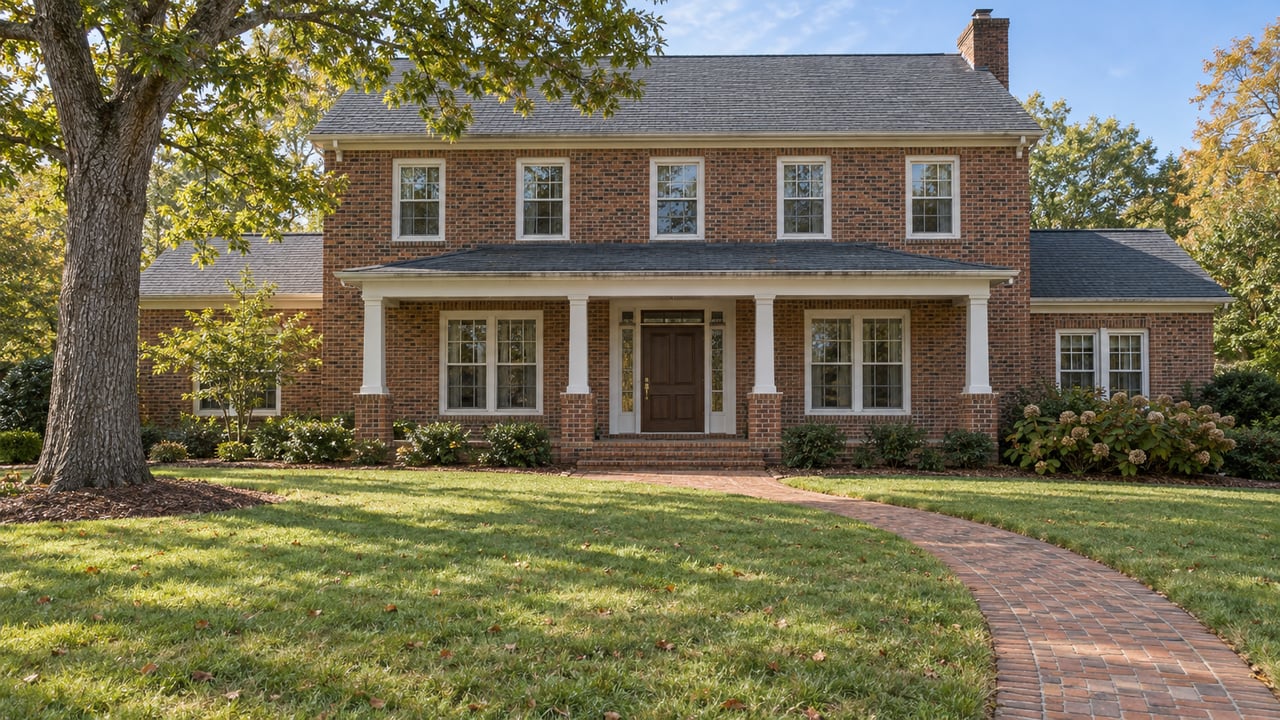
The Autumn Lakes Homeowners Association's dues sheet lists the expected items for a neighborhood built around water: common area landscaping, a foot bridge, a dock, a pavilion, entrance signage. It also lists two items most Pitt County buyers never see on an HOA bill, privately owned streetlights and privately owned streets and sidewalks.
For a buyer comparing this Grimesland subdivision with neighborhoods closer to Greenville, that one line changes the comparison. In much of the area, the state maintains the road in front of the house. In Autumn Lakes, the homeowners pay for the road through the association, and the bill for repaving it is large and getting closer.
What $925 a Year Is Carrying
The current dues are $925 per lot per year, with an assessment date of January 1, 2026. Those dues cover:
- General liability insurance and management fees
- Common area maintenance and landscaping
- Signage lighting and privately owned streetlights
- Privately owned streets and sidewalks
- The foot bridge, dock, and pavilion
- Entrance and signage maintenance
Owners handle everything on their own lot: the house inside and out, fences, driveways, pest and termite work, and their own HO3 insurance policy.
Judged as a yearly fee, $925 looks modest. The more useful question is how much of it has to go toward replacing things that wear out, and the streets are among the largest of those things.
The Paving Bill the 2022 Study Saw Coming
The association's full reserve study is dated February 1, 2022 and was built from a site inspection on January 13, 2022. It counted 22 components the HOA would eventually need to repair or replace. They include concrete paths, asphalt repair and resurfacing, a gazebo, lake erosion control, retention ponds, two phases of wood bulkheads, entry signs, pole lights, pond fountains, the pavilion and main dock, and the bridges and docks, which are listed for both resurfacing and full rebuilds.
The wood bulkheads carry larger cost estimates, at $282,000 for Phase 1 and $280,000 for Phase 2, and so does retention pond maintenance at $275,000. Those items have longer remaining lives in the study. The asphalt lines matter for a different reason, because they are the streets themselves and the first resurfacing date is close:
| Component | 2022 cost estimate | Forecast year | Forecast cost |
|---|---|---|---|
| Asphalt (2008) resurfacing | $191,000 | 2029 | $234,906 |
| Asphalt (2020) resurfacing | $173,500 | 2040 | $295,372 |
| Asphalt repairs | $4,700 |
The 2029 resurfacing is about three years away. The study's opening position is what makes that date matter. As of January 1, 2022, it put the reserve balance at $0 against a fully funded balance of $837,915. That works out to 0.0% funded and an average deficit of $10,218 per unit. It also listed the most recent reserve contribution rate as $0 and rated the association's risk of a special assessment as "High." To begin closing that gap, it recommended $57,400 in reserve contributions for fiscal 2022, increasing every year after that.
For scale, $10,218 is roughly eleven years of today's $925 dues. That comparison mixes a 2022 shortfall with 2026 dues, so it describes the size of the gap the study found. It does not tell you where the reserve stands today. The study calls itself a one-year document that needs annual updates, and it says its cost and timing projections are not guaranteed. The study also forecast no reserve special assessments for fiscal 2022 through 2026. That was a projection based on a recommended funding plan, not a record of what the HOA actually collected.
So the first thing to ask for in Autumn Lakes is the current reserve balance and the most recent update to that study. The dues figure alone won't tell you whether the 2029 paving can be paid from savings or will have to be raised from owners when it comes due.
Two Kinds of Street Inside One Neighborhood
The board went at the street problem directly. At an August 21, 2024 special meeting attended by 24 homeowners, it reported that Autumn Lakes' streets fall into two legal categories.
Phase 1 was created with private streets. The minutes say this cannot be changed, so private maintenance is the only option there. The streets in the other sections are public roads that the HOA currently maintains, and the board's plan was to hand those over to public maintenance to save the association money over time. According to the minutes, the homeowners at the meeting supported the idea and no one objected.
The minutes lay out the handover process in order:
- Every homeowner on a given street must agree and sign the required form.
- A quote is then obtained for any maintenance the street currently needs.
- That cost is charged to those homeowners on their tax bills, spread over 10 years.
- After that, the road is publicly maintained permanently.
That plan matches how North Carolina handles subdivision roads in general. The NCDOT subdivision roads manual says publicly designated subdivision roads can be added to the state system and private roads are not eligible. An addition starts with an SR-1 petition from the developer or property owners, along with right-of-way dedication and roads that meet the state's construction and maintenance standards. The petition forms are posted on NCDOT's Secondary Roads and Subdivisions page. The tax-bill repayment in the minutes follows a county model. Pitt County adopted a Street Assessment Policy in June 2013 that lets residents petition the county to pay for the repairs NCDOT requires before a takeover, with residents repaying the cost through their annual tax bills. That is according to the county Planning Department's annual report from that year.
The dues sheet carrying the January 1, 2026 assessment date still lists privately owned streets and sidewalks among the items dues pay for. Because of that, a buyer should know which kind of street a house is on:
- On a Phase 1 street, the road stays private permanently. Its upkeep and eventual resurfacing come out of association funds every time.
- On a street in another section, the road is public but maintained by the HOA. If every owner on that street signs and the handover goes through, the owner may carry a 10-year repair charge on the property tax bill instead of through the HOA. Because the process needs every signature, one owner who declines can hold up the whole street.
The second case adds a cost that sits outside the HOA entirely. A 10-year assessment would show up on the tax bill, so a buyer reviewing only the association's paperwork could miss it.
What the Disclosure Paperwork Covers
North Carolina gives buyers a standard first look at HOA obligations. The North Carolina Real Estate Commission's Residential Property and Owners' Association Disclosure Statement says N.C.G.S. 47E requires the owner to provide the statement before an offer. Its owners' association section asks about regular dues, approved changes or special assessments, transfer fees, and any association litigation or violations.
The Autumn Lakes HOA documents also include a 2025-labeled Owners' Association Disclosure Addendum, Standard Form 2A12-T. It lists "N/A" for other dues, fees, or special assessments payable by owners, and "N/A" for association and management-company transfer fees, including document preparation and statements of unpaid assessments. The form's own printed note says it is meant for cases where the RPOADS form is not required or where the parties agree to use it.
These forms record what has already been decided. A 2029 paving cycle that hasn't been funded, or a street handover still waiting on signatures, won't appear as a line item until a board votes on it. For that part of the picture, the useful documents are the reserve study and its updates, the board's meeting minutes, and the subdivision map that shows each phase.
North Carolina's Planned Community Act, Chapter 47F, sets the framework. Subject to statutory exceptions and the declaration, the association must maintain, repair, and replace the common elements, and it may assess owners to recover those costs. The statute allows associations to budget for reserves. It also lets them charge a reasonable fee for a statement of unpaid assessments, which must be delivered within 10 business days. The fee is capped at $200 per request, plus up to $100 for an expedited request made within 48 hours of closing.
FAQ
How can I tell whether a house is on a Phase 1 street? The association's posted documents include an Autumn Lakes subdivision map and a common area map. Those, along with the recorded plat, show which section a lot is in.
Are the dues still $925? That is the rate on the information sheet tied to the January 1, 2026 assessment date. Before you make an offer, confirm the current rate and the next fiscal year's budget with the association's manager.
Do the dues fund the dock and bridges too? Yes. The foot bridge, dock, and pavilion are listed among the items dues cover. The 2022 reserve study also includes bridge resurfacing and rebuilds, a small-bridge rebuild, and a dock rebuild among its components.
This post is general information, not legal, tax, or financial advice. Please confirm how any HOA document, statute, or assessment applies to a specific property with a real estate attorney or other qualified professional.
If you're considering a home in Autumn Lakes, I can help you get the current reserve figures, the latest board minutes, and the phase map in hand before you set your price, so the street in front of the house is part of your decision from the start. Reach out to Kunny Brothers. Let's Connect.
